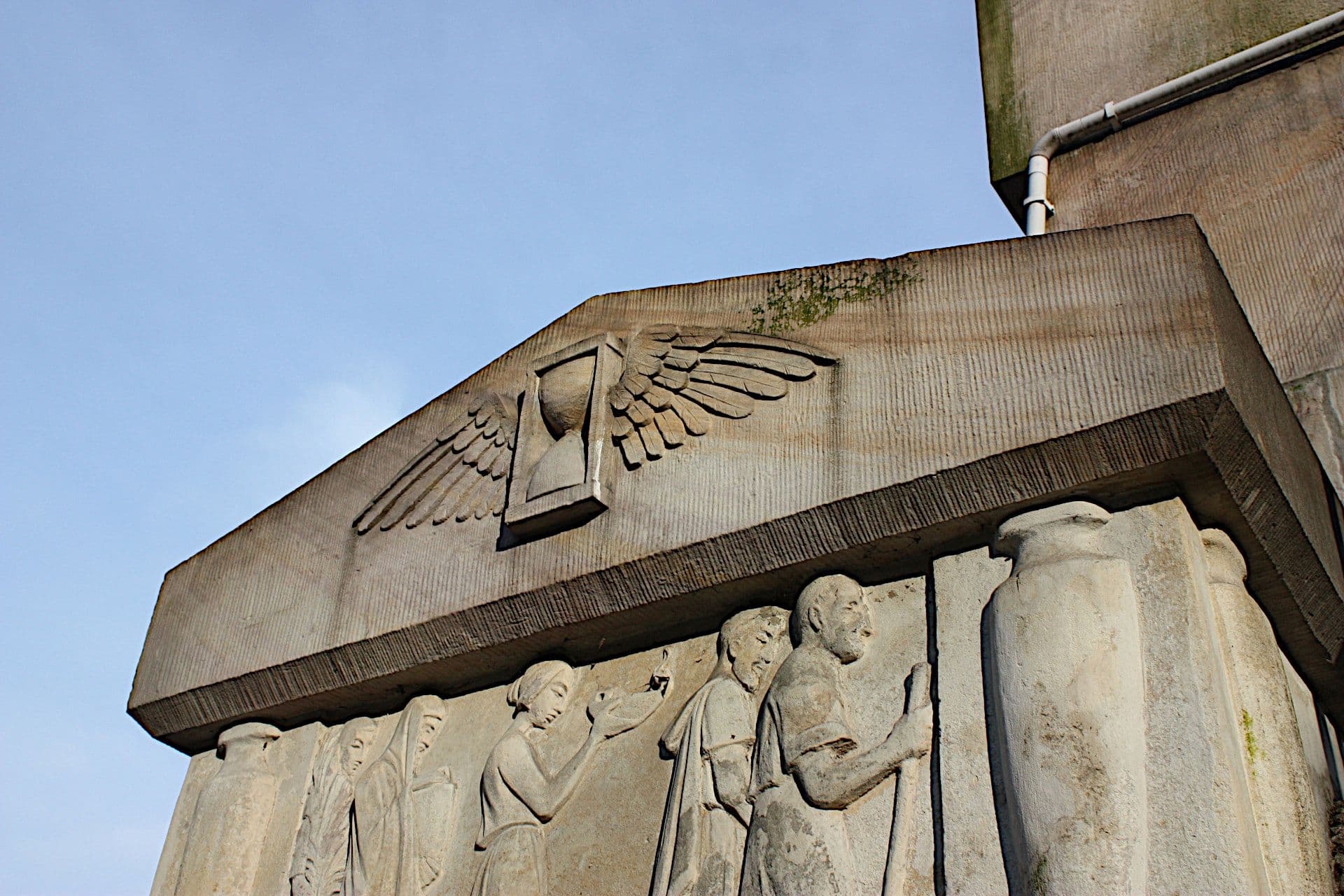
Every year on All Saints' Day and All Souls' Day, increasingly often grouped under the shared, though non-traditional, name of the Day of the Dead, the media report on collections held at Warsaw's historic cemeteries. The fundraisers include both people well known from the theatre, cinema and television, as well as anonymous volunteers. The campaign continues to gain momentum and draws public attention to the necropolises as an important part of the national heritage.
On 3 July 2014, by decree of the President of the Republic of Poland, Bronisław Komorowski, the Catholic, Jewish, Caucasian, Tatar, Evangelical-Augsburg and Calvinist cemeteries were recognised as a historic monument, forming a complex of historic religious cemeteries at Powązki. Not all of these cemeteries lie within the historic boundaries of the former village of Powązki, a fact that was duly acknowledged in the wording: "in the Powązki area within the Wola district." Military Powązki was not included either, since from 1 January 1964 until 1998 it was designated a municipal cemetery, until the Warsaw Council restored its old name. The decree emphasised the role of this material record, which attests to the existence of a multinational and multi-faith Commonwealth, and noted that Powązki—as Warsaw's oldest continuously active cemetery (although officially only for those with family graves there)—is the centrepiece and the unifying link of the entire complex, its heart.
The significance of the cemetery was recognised quite early on. Kazimierz Wójcicki was the first to write a three-volume guide, in 1855–58. In the 1980s, three of Stanisław Szenic's four volumes were published, and in 1982, thanks to the Committee for the Care of Old Powązki, the first edition of a cemetery guide appeared, with texts by Hanna Szwankowska and Danuta Jędryczko. The Committee later published further editions, expanded to include biographies of people who had died in recent years. In 2006, a highly reliable study by Tadeusz Maria Rudkowski was published, summarising the research of his predecessors and presenting new facts.
One of these works stands apart as the finest and unrivalled, because it was written by a legendary figure who was himself inseparably bound up with the city that no longer exists. Once he had passed Beyond the Gate of Great Silence, as he titled his book, a piece of metalwork, a photograph or the address of a stonemason's workshop on a gravestone would bring entire streets before his eyes. What is, for us—even for the few whose great-grandparents rest in Warsaw's cemeteries—only a trace of a lost Atlantis was, to him, a real fragment of life. Jerzy Waldorff, related through his mother to the Szustr family, returned to what Jeremi Przybora so aptly called "Warsaw stripped of its Warsaw-ness," and pondered how to save what remained of the old city. He taught people to see Powązki as more than just a cemetery.
He showed that it is a gallery of Polish sculpture, featuring works by the greatest artists over nearly two hundred years. He saw Powązki as a calendar of Polish history and, in a sense, a social chronicle of the capital.
Who isn't buried at Powązki! Every name has a story, often a romantic one. For example, Maria Assunta de Ligouri, a Venetian princess educated in England, stayed in Poland against her father's wishes. When he heard that she had married Antoni Uniechowski, who was madly in love with her but earned his living as a painter and was six years her junior, he announced that he would disinherit her. The spirited young woman, known in the family as Marytka, was not intimidated by her father's anger. She moved in with her husband, child, mother and maid, to three enfilade rooms on Krakowskie Przedmieście. She even helped another young woman—intelligent and not unattractive, but unlucky enough to have an excessively critical father—find a husband. When the suitor of his only daughter failed to meet with his approval, he greeted him in his long johns.
In another part of the cemetery lies Leopold Kronenberg, who converted to Catholicism so that he could be buried beside his beloved wife, the singer Józefina Reszke. The well-known story of the actress Maria Wisnowska, shot dead by a Russian officer and described by Russian Nobel laureate Ivan Bunin, was a major scandal in nineteenth-century Warsaw. An affair with a Russian was considered treason, as was marriage. Orthodox Christians were not even welcome in other cemeteries—not only in Catholic ones, where the government had to intervene in 1819. They were also unwelcome in the Protestant cemetery, where Orthodox Christians had purchased a plot as early as 1795 and bought another in 1832. The establishment of an Orthodox cemetery in Wola provided the perfect pretext. It was not, as one might think today, a matter of religious difference. There were many interfaith marriages. Rather, Orthodoxy simply—and wrongly—began to be identified with Russia. Most of the deceased were Russian soldiers or officials engaged in Russification. In 1721, Peter I abolished the Moscow Patriarchate and established the Most Holy Governing Synod, headed by a secular Chief Procurator. This meant that the tsar was, in effect, the head of the Russian Church, and the clergy were therefore treated as his officials. In addition, churches were converted into Orthodox churches, permission to build new ones was rarely granted, yet 42 Orthodox churches were built in Warsaw and the surrounding area, mainly for the military. While in St Petersburg, at the Institute for Noble Maidens, Catholic girls of various nationalities studied alongside Orthodox girls, and Poles working deep in the Empire made many Russian friends, in Warsaw this was almost impossible. In St Petersburg, the law allowed couples in mixed marriages to choose which church would baptise their daughters; by law, their sons were Orthodox. In Warsaw there was no choice: under the law, all children became members of the Orthodox Church, and even adults from such families faced many difficulties when converting.
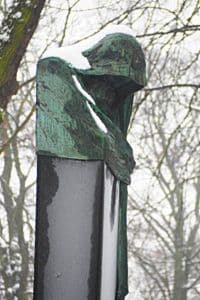
The tomb of the Fruziński family.
No one knows exactly how many graves there are at Powązki, let alone how many people have been buried here. Tadeusz Maria Rudkowski noted that there are 429 sections, uniform in character but not in size. Each has six rows, though the number of graves in each row varies. Estimates of the number of people buried here range from 800,000 to as many as 2 million. It is most likely, then, that over a million people are buried here.
The vast majority shared a sense of patriotism and a commitment to social and political causes. The same cemetery is the resting place of Konrad Prószyński, a deportee, member of the National League, founder of Gazeta Świąteczna and author of Obrazkowa nauka czytania i pisania (An Illustrated Guide to Reading and Writing), which won an award and was recognised as the best of its kind at the international exhibition of the London Pedagogical Society in 1893; and Wacław Święcicki, also a deportee and an associate of Ludwik Waryński, who wrote The Warsaw Song of 1905, famous throughout revolutionary Europe and extraordinarily popular in the Soviet Union from 1937. Its lyrics were changed, however: "No one dies in vain for an idea; in time, Christ triumphs over Judas!"
Buried at Powązki is engineer Stanisław Kierbedź, designer of the first permanent bridge over the Neva. A great Polish patriot, he was promoted to the rank of general in the Tsarist army for his work. Antonina Leśniewska was an equally ardent patriot and the first woman in Tsarist Russia to earn a master's degree in pharmacy. In St Petersburg, in the building of the Polish Charitable Society beside St Catherine's Church, she established Europe's first pharmacy staffed entirely by women. She also founded a school of pharmacy for women. Another deportee and scholar, Benedykt Dybowski, was a naturalist, Darwinist and teetotaller. Buried at Lychakiv Cemetery, he has a commemorative plaque here.
Powązki is also the resting place of forgotten pioneers of organic work, such as Edward Czaban. After studying in London, he went into the timber trade in England and France. Before his death, he returned to his native Warsaw and bequeathed 525,000 roubles in his will for religious, scientific, educational and humanitarian purposes. His generosity extended beyond his hometown: the Polish Academy of Arts and Sciences in Kraków received 50,000 roubles from this sum, while the universities in Kraków and Lviv each received 30,000.
A distinct group was made up of educational activists, teachers and proprietors of girls' boarding schools. They and their pupils took an active part in the life of the nation, often joining the struggle, even taking up arms. Among them were Barbara Czarnowska, a participant in the November Uprising, and Zofia Trzcińska-Kamińska, a sculptor who fought in the Legions; they are neighbours here at Powązki. Their example helped us endure so many years of captivity, and thanks to women like them, Polish women were among the first in Europe to gain the right to vote. Exceptionally well brought up, they never confused one thing with another. They knew that being kind and well-mannered was certainly not the same as being powerless and submissive. Minister Tolstoy feared these women. In a post-uprising circular to Warsaw schools, he declared that the worst thing about Poland was its women: they had no feminine nature, and he had never seen greater fanatics—especially among those educated in convent schools. It is hard to blame him, given that Mother Marcelina Darowska, founder of the schools in Jazłowiec and Szymanów, criticised the Russian boarding school she had attended for teaching her pupils to keep up appearances. As she put it: "The erasure of character is a misfortune […]. People without distinctive qualities, who efface their individuality for the sake of others, are usually deficient either in intellect or in character."
Most women involved in education in Poland thought similarly, and many of them are buried at Powązki. They include Jadwiga Sikorska, Jadwiga Kowalczykówna and Jadwiga Jawurkówna, the Posselt sisters, and Jadwiga Reutt. The school she founded with Cecylia Plater-Zyberk introduced an unprecedented innovation: in this girls' school, serving at Mass was the pupils' responsibility. At the headmistress's request, their neighbour Achilles Ratti granted permission. Many remarkable women graduated from the school, among them Anna Przedpełska-Trzeciakowska, a distinguished translator of English literature; Krystyna Zachwatowicz-Wajda; Professor Anna Świderkówna; and Magdalena Grodzka, a pioneer in working with autistic children, who recalled her time there with immense gratitude and affection.
That is reason enough to want to return to Powązki again and again. All you need to do is pass through the St Honorata Gate, one of the cemetery's seven gates—and the only one that is always open.
Anyone doing this for the first time and approaching the map displayed on the board with confidence will quickly notice that it is irregular, and that the sections are numbered with Arabic and Roman numerals and marked with uppercase and lowercase letters. What is more, at first glance the numbering seems completely illogical: for example, section 181 is next to section 1 and the first gate, while section 182 lies beyond the section marked with the letter "J", closer to the sixth gate. It is as if the spirit of the king—the founder—were entertaining his guests with a game of blind man's buff, so often depicted in eighteenth-century paintings. The prosaic explanation is different. The sections were numbered whenever another plot of land was incorporated, and, as we can see, not in sequence. After the Second World War, a new numbering system was proposed, but fortunately nothing came of it, as it would have made it harder to find graves using old documents and erased traces of the cemetery's development. To avoid getting lost, you need to walk with a map in hand and consult it carefully, because Powązki holds plenty of surprises, even for regular visitors. What were the beginnings of Powązki? On 4 November 1790, St Charles Borromeo's Day, in a field outside Warsaw, on land donated for a public cemetery—as the inscription on the family tomb of the noble donors, the Korwin-Szymanowskis, proclaims—King Stanisław August Poniatowski of the Polish-Lithuanian Commonwealth founded the first National Pantheon after Wawel. Neither the donors nor the founder had any idea of this, although they set aside places for the chosen few in the catacombs. Just twenty years earlier, Marshal Stanisław Lubomirski had surrounded the city with ramparts intended to protect it from plague. Efforts were made to improve public health and sanitation. The main concern was to encourage the people of Warsaw to bury their dead in the new cemetery. The first funeral, that of 32-year-old Marianna Kołodziejska, did not take place until February 1792. To understand this, we should briefly recall the history of burial places in Christian Europe. The first Christian cemeteries, naturally separated from pagan ones as early as the third century, were located far outside towns, in keeping with Roman tradition and the Law of the Twelve Tables, formulated in 451–449 BC. The Church not only accepted the Roman custom of granting cemeteries special protection, but from the very beginning placed them under the care of bishops and priests. As sacred places, they were also covered by the right of asylum, finally codified by Pope Innocent III in 1200. In 1059, the Council of Rome ordered that cemeteries be established around churches, probably in an effort to protect them effectively from desecration, since the same council excommunicated anyone who profaned a cemetery.
No one objected to their location in the centers of human settlements, because Christianity, unlike the Romans and Jews, did not consider the dead to be impure. This stemmed from belief in the Incarnation of Christ (the Son of God taking on human nature and a human body in order to accomplish the work of salvation—a process the Church calls the Incarnation), through which he sanctified every body. Only people excluded from the community of the Church, such as suicides, were buried somewhere far out in the fields. (The last of many changes to this rule, permitting a Catholic funeral, was introduced in the Code of Canon Law only during the pontificate of John Paul II.) This practice was bound to lead to a public health disaster. Efforts to counter it began first in France, since Paris was then the foulest-smelling city in Europe. In 1735, the Parliament of Paris sent doctors a questionnaire about cemeteries, and ten years later, Father Porée published Lettres sur la sépulture dans les églises, recommending in his work that the dead be separated from the living, following the example of the ancients. In that same year, in Warsaw, the Congregation of the Mission priests from the Church of the Holy Cross began efforts to establish a new cemetery outside the city, naturally just for their own parish, since at that time every parish church had its own cemetery. Monasteries and hospitals also had their own cemeteries. The Protestant cemetery for both denominations was located in Leszno. Unfortunately, the Missionaries lacked the funds, and the cemetery known as Świętokrzyski, after the church, was not established until 1781, at what could be called the foot of today's Marriott Hotel, between present-day Nowogrodzka, Wspólna and Emilii Plater streets. Although 36 years passed between the idea and its implementation, during which several important laws and proclamations concerning cemeteries were issued—such as Louis XVI's declaration of 21 May 1776 and the instruction On Establishing Cemeteries Outside the City of Warsaw for the Burial of the Dead, issued by Bishop Młodziejowski, an ally of Stanisław Lubomirski's reforms—this did not change people's attitudes. Of course, no one wanted to be buried in the new necropolis because, as mentioned above, burial in a field, once reserved only for those excluded from the Church, was associated with disgrace.
That is why, for a long time, bodies were still brought under cover of night to the old cemetery at the Holy Cross Church. Bishop Młodziejowski took it upon himself to persuade the secular clergy; the religious orders, reluctant to change, proved more difficult to convince. Prejudice was overcome only after the burial of the Bishop of Smolensk, Gabriel Wodziński, whose gravestone bore the inscription Hic sepeliri voluit (he wished to be buried here), and of other widely known figures, such as Stanisław August's morganatic wife, Elżbieta Grabowska (a morganatic marriage was one contracted by a member of a reigning house with someone of lower rank, who, along with their children, did not acquire the right to a title or to inheritance), or General Michał Sokolnicki. The second reason was very practical: coffins were carried on people's shoulders, and mourners walked in the funeral procession, so distance mattered greatly. The Missionaries were the first to introduce hearses for transporting the dead, but mourners continued to accompany the deceased, and this tradition persisted until the Second World War. It was vividly described in the book Antoni Uniechowski o sobie i innych by Krystyna, daughter of the renowned illustrator Antoni Uniechowski, who watched funeral processions from the window of her parents' apartment: "The route along Krakowskie Przedmieście was also used for ordinary funerals. Those heading for Powązki turned into Miodowa Street, while those bound for Bródno went down Nowy Zjazd towards the Kierbedź Bridge. Motorized funeral processions were neither fashionable nor widespread in the 1930s. The whole family trudged on foot behind the traditional hearse, whatever the weather. There were all kinds of hearses. The poorest were small platforms covered only with black cloth, on which a poorly secured little coffin bounced along; no member of the clergy, and often no family member either, accompanied it to its final resting place. Other hearses had canopies topped with a cross supported by four little columns, gathered black velvet drapes, silver mourning emblems, tin wreaths, and both artificial and fresh flowers. The procession was led by a priest and boys in surplices, while behind them the family, dressed in black and their veils fluttering, marched in disciplined formation. The most elegant, and consequently the rarest, were entire catafalques resembling glass display cases or cages, sometimes drawn by four black horses adorned with plumes. They had two coachmen in special liveries edged with braid, and altar boys in lilac capes carrying bells, crosses, and lanterns. Several horse-drawn cabs followed the procession, carrying elderly family members. There were also more official funerals, attended by delegations from guilds or institutions, with solemn gentlemen carrying the deceased's decorations and medals, pinned to crimson cushions, behind the priest. Sometimes there were bands, playing funeral marches in honor of a fellow soldier or firefighter, the brass instruments sounding grim and lifeless." When the cemetery at Powązki was established, it seemed that the Missionaries had already blazed the trail, and yet history repeated itself. This time, the new Holy Cross cemetery was preferred, also because it lay within the boundary marked by the Lubomirski Ramparts. It was no longer associated with being cast "out into the fields," which, as Jacek Kolbuszewski writes in his book Cemeteries, was considered "a dog's burial."
The cemetery in the village of Powązki initially covered just 2.6 hectares and belonged to three parishes: St John's in the Old Town, the Church of the Blessed Virgin Mary in the New Town, and St Andrew's (the predecessor of today's Church of St Andrew on Theatre Square). Although administered by these three parishes, it held a very different standing from the other necropolises. It was founded by the king, who commissioned the design of the catacombs and of the church, jointly funded with his brother, Primate Michał Poniatowski, from one of his favorite architects, Dominik Merlini, creator of the Palace on the Isle. The first church, consecrated on 21 October 1792, had a single nave and a Doric-order façade. It was dedicated to St Charles Borromeo, patron saint of the poor, patron of the arts, and author of Instructiones, a Counter-Reformation handbook on the use of art in propagating the faith. Henryk Marconi later drew on the guidelines it contained when building the church on Chłodna Street. The cult of St Charles appeared in Poland very early: the first painting was brought to Niepołomice by Anna Branicka née Myszkowska, and testimonies from the Polish royal couple, Sigismund III Vasa and his wife Constance, were even used in the process of his beatification. The king's brother, of infamous memory, regarded this man—so modest that he would not even allow himself to be portrayed—as a model priest and wished to emulate him. This explains the church's dedication and the painting in the high altar, although it was neither the only nor even the most important reason. Like every monarch, Stanisław August communicated with his subjects through highly legible visual symbols. Each of his residences and every work of art accessible to the public had a carefully considered iconographic program. As an enlightened monarch whose dream was to educate a new society, he believed in the power of education and attached great importance to promoting it through art.
Tomb of Zygmunt Słomiński.
But this was not the end of the message. The king was addressing educated people who spent their days enjoying intellectual games, and were therefore familiar with the sources from which artists drew inspiration and aware of the most famous model: Titian's painting Noli me tangere (the meeting of Mary Magdalene and Christ before the open tomb). This allusion recalled the sacred nature of the king's authority as God's anointed, and the consequences that flowed from it. During the reign of Stanisław August, three more cemeteries of significance to the city were established. In 1792, the ruler gave permission for a Jewish cemetery to be founded on his estate in Targówek. Its initiator and capable administrator was the royal supplier and banker Szmul Zbytkower. The following year, the already-mentioned Świętokrzyski Cemetery was established, and in 1792 an Evangelical cemetery was founded on land leased from the banker Karol Schulz, on his Wielka Wola estate. The cemetery's excellent design and precise layout were a gift from the eminent architect Szymon Bogumił Zug, creator of one of eighteenth-century Warsaw's most beautiful buildings, the Holy Trinity Church. The cemetery founded by the king was, however, of exceptional significance, and not only because of the monarch himself. From the outset, it was an expression of tremendous social solidarity: alongside well-known benefactors such as the Szymanowski family, Bishop Okęcki, Primate Michał Poniatowski, Prince Czartoryski, and priests Stefan Łuskina and Karol Wyrwicz, whose generosity cannot be dismissed as mere propaganda—that would be unfair and a gross oversimplification—funds also came from the Warsaw chapter and many anonymous donors. In August 1794, during the Kościuszko Uprising, a man who had earned widespread hatred was buried in the catacombs. He died amid scandal; rumours spread that he had poisoned himself for fear that his treason would be discovered. Few remembered his work on the Commission of National Education, his efforts to raise the standard of seminaries, or the fact that—as Franciszek Maksymilian Sobieszczański recalled—"for the proper education of the peasants, he ordered schools to be maintained in every parish and rectory, and ensured that they fulfilled their purpose." Father Jan Paweł Woronicz preached at this man's funeral, and the following was engraved on the catacomb plaque: "Michał Jerzy, Prince Poniatowski, of the Ciołek coat of arms, Primate of the Crown of Poland and the Grand Duchy of Lithuania, son of the Castellan of Kraków and Princess Konstancja Czartoryska, born on 11 October 1736, died on 11 August 1794. He asks faithful Catholics to pray for his soul." On 24 October 1795, the third partition of Poland was signed. The king left for Grodno, and later for St Petersburg. The state ceased to exist.
Despite the greatest revulsion and hostility towards Prince Michał, the office he held gave him a position second only to the king—or, during an election, the person who stood in the king's place—as the most important figure in the state. The dignity of the office, even when disgraced, also enhanced the significance of the primate's final resting place, making it a testament to the former fame and glory of the Commonwealth. From then on, the cemetery became a stone book of the nation's history. Enlightenment figures—Kołłątaj, Bishop Albertrandi and Father Bohomolec—were buried in the seven-tier catacombs. The coffin of Dominik Merlini was laid there too. Soldiers of the Kościuszko Uprising were buried alongside civilians in 18 plots between the church and the catacombs. Stanisław August, who looked for hidden meanings everywhere, would surely have noticed another eighteen. That was the number of times new parcels of land were added to the cemetery, acquired through donations, purchases or expropriation. The first was in 1813, the last in 1928. Today, it covers almost 44 hectares. The Commonwealth had disappeared from the map, but the nation still existed and had no intention of surrendering. More patriots were laid to rest—alongside the soldiers who fell in the Kościuszko Uprising, Napoleonic soldiers too, and, in 1819, Kiliński himself.
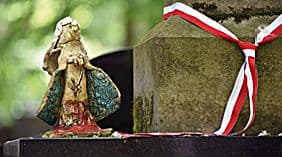
Irena Sendler's tombstone.
On 13 January, the dress of Princess Teresa, resting by the fireplace in the Blue Palace (the Zamoyski Palace), caught fire. Despite Norblin's valiant efforts to help and immediate medical attention, the tragedy could not be prevented. Princess Izabela was then in confinement, but her newborn daughter Gabriela died, adding to the family's grief. The Czartoryskis left Warsaw and no longer received visitors there or at Powązki. Their employees, however, continued to tend the neglected garden, and not everyone accepted that its owner was absent: even the most authoritative sources repeated for years the rumour that the cemetery had been established there simply to spite that lady. After the November Uprising, the situation was entirely different.
Tsar Nicholas I ordered the construction of a citadel in Warsaw, of course at the expense of its inhabitants. In one fell swoop, he destroyed the buildings of the boarding school built by the Piarists on a site they called Joli Bord (the school itself was closed a year later) and halted the city's territorial expansion for more than 80 years, encircling it with a ring of forts. Warsaw became a vast military camp. In the Wola trenches, where Sowiński fell, a cemetery for the soldiers of the victorious Russian army was established around the Church of St. Lawrence, which had been converted into an Orthodox church; civilians were later buried there too. People who had lost their property for taking part in the uprising also came to the city. The cemetery began filling up faster and faster, although most people still buried their dead there with heavy hearts, noting on the grave what land the deceased had been a citizen of, so that no one would suspect him of being a city commoner (a derogatory term for a townsman). One example was the estate manager Wirski, a poor former landowner. The memory of the ban on the nobility engaging in crafts or trade, under threat of losing their noble status, was still very much alive, and the word "merchant" long sounded like an insult. Fortunately, this began to change slowly only after the January Uprising, under the influence of Positivism. The best evidence of this was one of the most Warsaw-centric books, Bolesław Prus's The Doll; nevertheless, aversion to trade persisted for a long time. As late as the 1930s, General Grot's only daughter and Melchior Wańkowicz's two daughters caused a scandal throughout Żoliborz when, independently of one another, they decided to supplement their pocket money by selling their own roses at Wilson Square. They were duly reprimanded. Any honest work, even far below one's qualifications—yes; trade—no. In 1836, the Holy Cross Cemetery was closed, and the Ujazdowski Cemetery followed two years later. Powązki became the city's only Catholic cemetery. In 1837, it was taken away from the Church and placed under the administration of the Municipal Office. From then on, fees were paid exclusively at City Hall, and prices were even set for different types of burial, divided into six classes. This had its advantages: previously, the cemetery had been run by three parishes. The paths were tidied, registers began to be kept, and plots were numbered. The choice of cemetery superintendent was also very fortunate: Ignacy Szulc, who systematically introduced beneficial improvements for 40 years. This does not change the fact that it was another act of discrimination against the Catholic Church, which the Russian authorities considered a bastion of Polish identity and resistance. Other denominational cemeteries remained under the administration of their own communities, although—as the occupying authorities would soon discover—non-Catholics could also cause plenty of trouble, with the exception of the Orthodox. The majority were Russians; those who were considered politically unreliable were sent home, like Prince Wołkoński, who had "gone Polish." In the 1840s, the first publicly announced fundraiser began to restore the cemetery and enlarge the church. Donors' names were published in the Warsaw Courier.
As a result, in 1850 Alfons Kropiwnicki extended the church southward and designed three new altars. He also doubled the length of the catacombs to 113 metres. A special hoist for carrying coffins to the upper levels was still in operation, just as it had been under Stanisław August. It was much needed. In 1852, cholera broke out, and there were as many as 300 funerals a day at Powązki. Across Europe, the Romantic period brought a return to history, the supremacy of the spirit over matter, and the veneration of ancestors. In Poland, it was also linked to the Messianic movement and fitted perfectly into a centuries-old tradition of communion with forebears (ancestors on both the father's and mother's sides), from pagan rites immortalized in Forefathers' Eve to the uniquely Polish custom, by European standards, of praying almost constantly for the dead. It was in Poland, in 1444, that people began adding a passage from the prayer Eternal Rest after the Angelus—for, as it was said, "the flower of Polish chivalry fallen in battle." It was here, too, that coffin portraits and the entire funeral ritual surrounding the castrum doloris (an ornate form of catafalque at which funeral rites were held) took shape. During the funeral, the priest would deliver a sermon to the deceased rather than to the mourners, as Henryk Sienkiewicz described so well in Pan Wołodyjowski. In the 19th century, during the Romantic period, the desire to create lasting physical memorials to the dead united believers with agnostics and atheists, and the fundraiser mentioned above is the best example of this. Since the authorities usually refused permission to erect public monuments to people chosen by Polish society, other solutions had to be found. Private estates, such as Wilanów with its monument to the Battle of Raszyn, were not open to the public at large. Cemeteries remained, and it was they that became places for expressing national sentiment. The first demonstration after the November Uprising was the funeral on June 11, 1860, when a procession of tens of thousands escorted General Katarzyna Sowińska to the Evangelical Cemetery. She was greatly respected for her extensive patriotic work and had been imprisoned for two years for collaborating with the Capuchin friar Beniamin Szymański, whom she helped smuggle insurgents across the border. The next was the funeral of the Five Fallen on March 2, 1861. It brought together clergy from all denominations (except the Orthodox). Soon, a policeman was stationed by the grave, and a monument was not erected there until 1915. The nearest cemetery gate was named after them and crowned with a crown of thorns. That funeral marked the beginning of Powązki's tradition, which continues to this day, of funerals as patriotic demonstrations. Later that same year, on April 8, 1861, despite a ban on public gatherings, students attended the funeral of the exiled Ksawery Stobnicki, then went from Powązki to the Jewish cemetery, to the grave of Eisenbaum, director of Warsaw's rabbinical school.
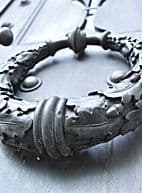
Part of the tomb of the Leopold Julian Kronenberg family.
Agaton himself, buried at the Sapieżyński Cemetery in Stanisławów, would not rest at Powązki until 1981, when his remains were brought from the cemetery in Ivano-Frankivsk, which had been destroyed during the Soviet era. Exiles and deportees form another Powązki epic. From most graves at Powązki, one can trace a line to other cemeteries in Poland and around the world. The Norwid and Chopin families are well-known exceptions. Children learn about them at school. The fate of many others forced to leave their homes is unknown to the general public. So too would have been the fate of the son of yet another landowner, eking out a living in a clerical post and married to a noblewoman long settled in Warsaw, had that son been an ordinary insurgent. But he became a painter and later St. Brother Albert (St. Brother Albert Chmielowski). Even less would be known about Mikołaj Kaczorowski, who worked as a coachman despite being highly literate, and his son Feliks, who set off for Kraków in search of work, to work for his family's former employer. Andrzej Artur Zamoyski was expelled from Warsaw after the attempt on Berg's life (an unsuccessful attempt on the life of Fyodor Berg, Viceroy of the Kingdom of Poland in 1863). He settled in Kraków and returned "home" after his death, but not until 1923. He was buried in the Church of the Holy Cross, for which he had funded a statue of Christ bearing the hope-inspiring inscription sursum corda (do not lose heart! Lift up your hearts!). Repression intensified after the January Uprising. Russian was everywhere—in schools, courts and street signs. People prayed in Polish in churches and Protestant congregations; from 1870, synagogues were ordered to teach in Russian, a requirement that Polish Jews, of course, did not observe. From 1870 onward, cemetery registers were also kept exclusively in Russian. The only places free from this forcibly imposed language were cemeteries, churches and the theatre. This was especially true of Catholic and Protestant cemeteries, since at the Tatar cemetery established in 1867 for soldiers of the Tsar's army, the gravestones
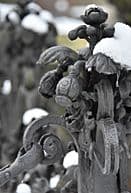
Tombstone of Roman Szewczykowski.
All of Warsaw streamed to Powązki, accompanying on his final journey a man who had heartened the nation long before Sienkiewicz. Raised by a father who had taken part in the Napoleonic campaign and a mother from an Armenian family that made Slutsk sashes (kontusz belts), Moniuszko was the very embodiment of Polishness. Today, we do not always realise how important music was at the time; it was an inseparable part of life. People made music at home, attended concerts and sang. The talented were loved and honoured, and collections were often organised to fund their tomb monuments. One example is the grave of Ignacy Komorowski, bearing the inscription "To the singer of Kalina, from his countrymen." The lasting fame of professional musicians was taken for granted. It is no coincidence that Moniuszko's tombstone—the creator of our national opera—bears only his surname. After the January Uprising and the enfranchisement of the peasants, another wave of migrants once again flowed into Warsaw. The number of funerals kept increasing, and the church became too small. Despite the city's mayor, Starynkiewicz—a Russian general appointed by the authorities—being extremely well-disposed towards the city and its residents, every church construction project required the approval of the Tsar and the city's military authorities, which was very difficult to obtain. A workaround had to be found, and one was: the documents described the project as a "church renovation." Between 1891 and 1895, a new church was built, laid out in the shape of a Latin cross, with a high dome at the crossing of the transept (the church's crosswise nave), modelled on the dome of the Church of St. Charles Borromeo in Vienna. Sadly, many graves were destroyed at that time, including those of Bogusławski, Kiliński, Kopczyński and Sarbiewski. Perhaps the most moving is the fate of Sarbiewski's mortal remains.
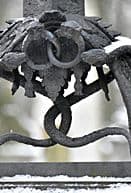
The tomb of Roman Szewczykowski.
The same atmosphere still prevailed around Powązki, and the area did not enjoy the best reputation, although it was home to reputable stonemasonry workshops and tanneries, which were much needed by a city renowned for the exceptional quality of its shoes. Two years later, war broke out, and at last we were able to fight for independence. In 1915, Mieczysław Landsberg funded a gate in honor of his beloved late wife, Honorata, named after her patron saint, and donated it to Warsaw with the approval of the city authorities. From then on, the Gate of St. Honorata, the work of Leon Wasilkowski, became a landmark of Powązki. In 1916, cemetery records once again began to be kept in Polish. In 1918, the nearby cemetery for Orthodox Russian soldiers was taken over by the Polish military authorities and placed under the administration of the Field Bishop's Curia. This is how the Powązki Military Cemetery came into being, a fact that still causes confusion today. The media do not always specify which Powązki they mean, so bewildered tourists end up wandering around the wrong cemetery. In 1916, nearby villages were incorporated into Warsaw. Many people still remember elderly residents saying "in Mokotów" and "in Czerniaków," just as we make mistakes when we say "in Natolin" and "in Białołęka" instead of "at Natolin" and "at Białołęka." Warsaw began to expand, and construction became possible in the area around the fortress. New, beautiful districts sprang up—Mokotów, Ochota, Nowy Żoliborz, Saska Kępa and Bielany. Yet space was becoming increasingly scarce, as people from all over Poland moved to the capital of the independent state. After its final expansion in 1928, the cemetery could no longer grow, and the city gradually enveloped it. In 1925, following the concordat, the cemetery returned to the Church. That same year, the Avenue of the Distinguished was created behind the catacombs, and Władysław Reymont was the first person buried there. Once again, crowds gathered for a national funeral—and, more importantly, the first state funeral. From that time on, holding state funerals for distinguished people would become a tradition.
Soon, the grief-stricken city mourned Stanisław Żwirko and Franciszek Wigura, winners of the international Challenge air competition in August 1932. Flying the Polish-designed RWD-6, they defeated their rivals, including the strongest contenders—the Germans. Significantly, Poland had officially sent its own representatives; until then, Poles had competed everywhere as citizens of the partitioning powers, which was often mistaken for their nationality. To this day, most Russian art historians consider Siemiradzki a Russian painter, although he always emphasized his Polish identity. Żwirko and Wigura died in a plane crash in September 1932, when a storm broke over Cieszyn Silesia. Two hundred thousand people attended their funeral, and the tomb in the Avenue of the Distinguished was designed by Franciszek Strynkiewicz. The role of funerary sculpture at Powązki as a way of paying tribute to distinguished compatriots remains significant, although sculptors now win state competitions to design monuments, which can finally be erected officially. Olga Niewska, Zofia Trzcińska-Kamińska, Henryk Kuna, Stanisław Ostrowski, the aforementioned Franciszek Strynkiewicz and many others did not regard such commissions as artistically inferior work. Another change was that people began consciously and freely choosing where they wanted to live. Many returned from abroad, giving up prospects for advancement and lucrative incomes there, as did the well-known, though not only, Ignacy Mościcki and Gabriel Narutowicz. Warsaw became their home. From then on, inscriptions at Powązki began to omit the word "citizen." On March 17, 1933, Warsaw witnessed another state funeral at Powązki. A procession carrying the coffin of Hiroyouki Kawai, a Japanese diplomat who had converted shortly before his death and been baptized after speaking with Father Maximilian Kolbe, a friend of his wife, set out from the Church of the Holy Cross. On September 1, 1939, war broke out. German artillery bombs severely damaged the church and 29 cemetery sections. The roof of the catacombs burned down. Some graves had to be levelled; others, damaged, remain to this day as a kind of lapidarium (a collection of historic tombstones). Hell broke loose in Warsaw. The city was divided into three parts, and the ghetto boundary ran just a short distance from the cemetery. Aid was brought in through the cemetery; weapons, food and people were smuggled through it, and even cows were driven across. Like other cemeteries, Powązki became a second home for Poles and Jews being hunted down. Even at distant Bródno, two men managed to frighten a child who was shouting to the cemetery workers: "There… there… In the grave! One dead man is reading a book, and the other is asleep and snoring." Warsaw kept up its courage, and most of society was involved in the struggle. Employees of municipal institutions provided immense support: the gasworks, power stations, waterworks, the Municipal Tram and Bus Authority, as well as the state postal service and railways. In all these institutions, employees had usually been members of the Polish Military Organisation (POW), the Legions, Haller's Army, or participants in one of the uprisings, so the principles of underground resistance were second nature to them. They have maintained this tradition to this day: the graves of their employees at Powązki are exceptionally well cared for, and the memory of those buried there has long been kept alive.
It was the craftsmen from the workshops of the Warsaw–Vienna Railway who saved the plaques from the closed Holy Cross Cemetery and placed them on the wall of St. Barbara's Church. In October 1941, Marshal Śmigły returned to Poland; in December, he died and was buried at Powązki under the name Adam Zawisza. In 1943, Soviet aircraft attempted to bomb Gdańsk Station, but the bombs hit the cemetery. After the Warsaw Uprising, many distinguished people were unable to return and remained abroad. As a result, countless graves were abandoned; they could not always be found, since the records had burned. Restoration of the catacombs began in 1946, but lack of funds meant the work continued until 1975. The church was restored over ten years, beginning in 1950. The work was led by architect Stanisław Marzyński. People had neither the wherewithal nor the money to care for the material legacy of the dead. Although they had not lost their sense of humour—the Eterek theatre revue was breaking popularity records—they really had nowhere to live. Jerzy Waldorff understood this and, inspired by a scene from The Doll, decided to organise a fundraiser to save the cemetery. In 1974, after discussions with the Curia and city authorities, he founded the Social Committee for the Care of Old Powązki. In keeping with the Polish tradition of placing great trust in artists, he enlisted them to take part in the fundraising collection. The first collection was held in 1975, with around 200 fundraisers taking part. Their numbers grew year after year. This did not protect Powązki from grave robbers. Even today, we hear of graves being vandalised: metal elements torn off, photographs stolen and crypts broken into. Despite all these difficulties, which the Committee began working to prevent, Powązki remained the National Pantheon, and funerals brought the nation together. The ashes of people from German concentration camps, kept in urns in Berlin, were placed in the catacombs. The Soviet Army handed them over to the Poles. Crowds also gathered here for the funerals of Grzegorz Przemyk and Father Niedzielak, who was murdered in the presbytery of St. Charles Borromeo Church while fighting for the truth about Katyn. In April 1991, a reliquary containing the skull of a Polish officer was brought from Yugoslavia. It had been taken from the site of the massacre by Miloslavic, a member of the international Katyn commission. The dead also gradually returned to Powązki. President Starzyński returned only as an inscription on a symbolic grave. Hanka Ordonówna was brought back by Jerzy Waldorff. Later, others followed, including Aleksandra Piłsudska and Marta Wańkowicz-Erdman.
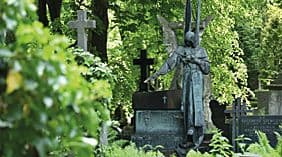
Tomb of Jan Gella
The cemetery is officially open only to people who have family graves there, but paradoxically, many old Warsaw families—even descendants of the donors, the Korwin Szymanowskis—are also buried in other cemeteries. The Blik family is in Skolimów, Fogg in Bródno, and Maria Hiszpańska-Neumann in Służew. Unfortunately, the necropolis attracts many snobs, and the archive, lost forever, makes this much easier. Granite-chip tombstones have appeared, but it turns out these are not the worst of it. The new monuments with figurative sculptures, squeezed between old graves and erected over the past decade, are not works of art. Of course, there are exceptions. Distinguished people are buried in the catacombs, in niches left empty since the war. Looking at the plaques commemorating Czesław Niemen and Andrzej Kurylewicz, or standing by Zbigniew Herbert's grave, one can reflect on the cyclical nature of history. Today, as in the 19th century, the most popular graves to visit are still those of freedom fighters and people of the stage. Although the city has changed, new houses and even a new housing estate have sprung up at Powązki and in the surrounding area—an estate inexplicably named Artistic Żoliborz. Perhaps the railway embankment is called the Beautiful Shore (another name for Żoliborz) because anti-aestheticism remains popular in art?—the cemetery still retains its old charm and atmosphere: a garden of remembrance and a garden full of greenery. Paradoxically, what has survived of old Warsaw is what is most ephemeral: its parks and gardens. And they, like the ending of The Doll, whisper to us non omnis moriar ("I shall not wholly die"), Horace's words symbolising that artists will always remain "alive" through their work.