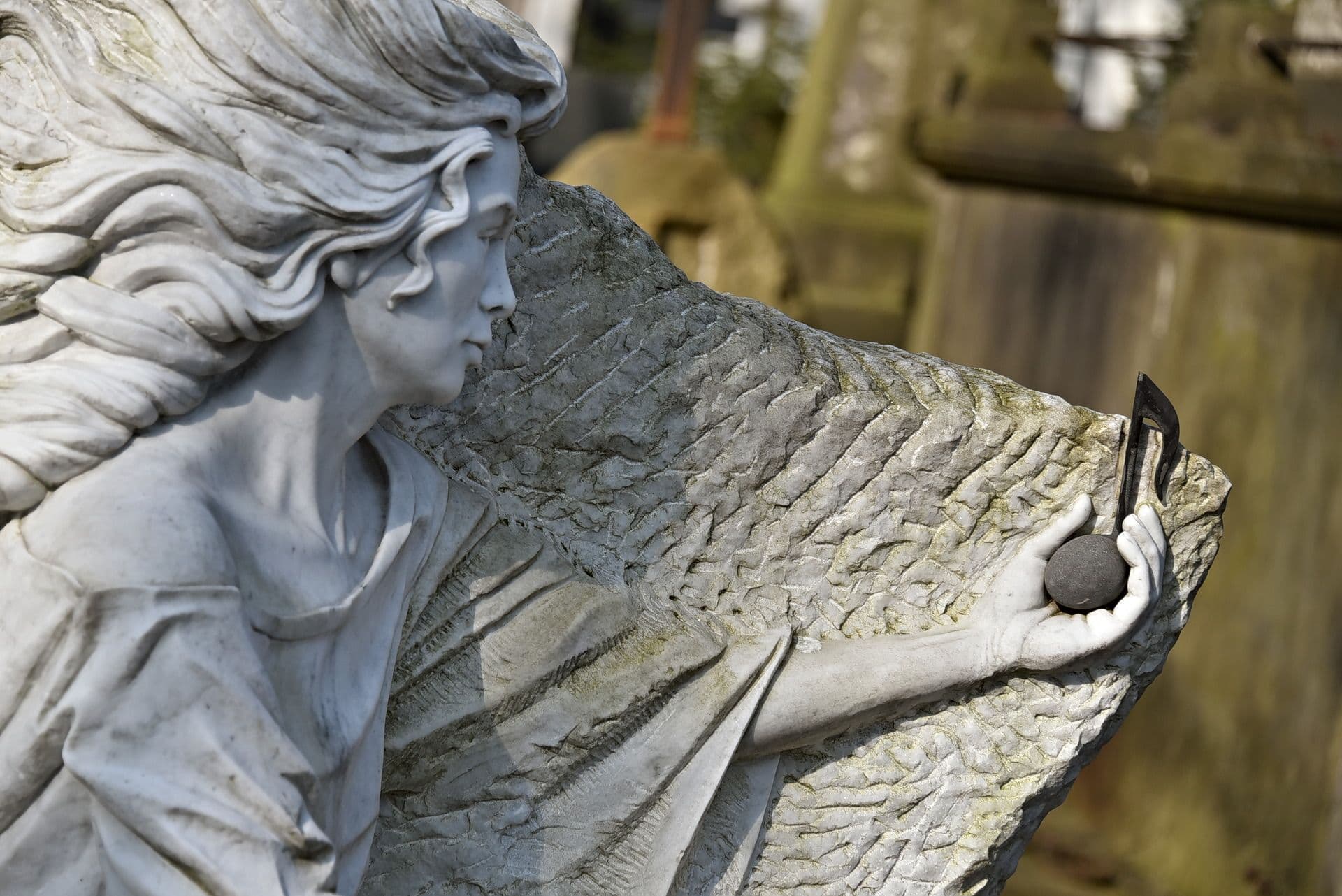
Every cemetery is a material record of a community's spiritual heritage, bearing witness to its history, customs and artistic taste. Warsaw's necropolis is no exception. Its unique role lies in its existence within a city that, at a certain point, ceased to exist. Literally, along with almost all its material heritage. First, the occupiers divided the property they found in the territories seized by their armies into two categories: things to be taken away and things to be destroyed. This is vividly illustrated by Okruchy brązu (Fragments of Bronze), the memoirs of Tadeusz Łopieński, one of the foremost artists in Warsaw's bronze-working tradition: "During the German occupation, the looting of works of art in the General Government reached apocalyptic proportions. Decorative works of art, including those made of bronze and brass, were looted and taken away, stripping all historic buildings bare. The few bronze-working workshops still in operation at the time, which had their own artistic products, were also searched and ransacked; objects of particular weight and value were confiscated as scrap, with worthless receipts given in exchange." Some objects found no "favor" in the eyes of the Nazis. Often, magnificent bronze works were smashed on Warsaw's streets, thrown from the windows of buildings. In 1941, Stadthauptmann Ludwig Leist sent a letter to J. Kulski, the city's acting mayor, concerning the removal of monuments as part of the »collection of non-ferrous scrap metal campaign« […]. After the fall of the Warsaw Uprising, the Nazis took metals (in every form) looted from the ruins of factories, palaces and churches out of the capital, above all monumental bronze statues. In the battered city, only a few statues, mutilated but miraculously saved from utter destruction, remained […] "After returning to my hometown, I was horrified wherever an empty plinth, a demolished pedestal or the marks left by a torn-off bronze plaque reminded me of what had passed." The destruction of the work of Warsaw's bronze-working, stone-carving and stucco workshops did not end with the war. Many surviving decorative features, such as the beautiful brass balustrade described in The Doll, were destroyed later. This was often due to neglect, dislike of pre-war Warsaw, and, most frequently, the fashion for functionalism. The slogan "Ornament is a crime," popular among architects with influence, was put into practice. Powązki was left alone, so everything that had not been destroyed by bombs survived. Thanks to the immense talent of our artists and craftspeople, such as the Łopieńskis, the Norblins, Zieleziński and Roman Szewczykowski, known as the Iron Florist, we can admire countless high-quality artistic tombstones, popular since the 1930s and 1940s
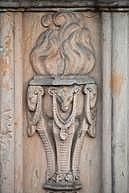
Detail of the Rostropowicz family tombstone.
The aristocracy—including the aristocracy of the spirit—and sometimes the wealthy bourgeoisie, who emulated them, chose busts or at least sculpted medallions. Photographs were long and unfairly regarded as a sign of poor taste; when funds were lacking, people chose a version without a portrait. It is worth looking at all the faces preserved in marble, limestone, sandstone, bronze, plaster or in photographs. This helps us understand customs and ways of looking at people. Most are realistic portraits, following the tradition of Roman portraiture and the school of Sarmatian coffin portraits that grew out of it. A radical change came only after the Second World War.
On today's gravestones, we often see photographs from early adulthood or from the period when the deceased looked, in their family's view, their best. The quintessential Powązki example is the grave of Nina Andrycz (section 14-1-2). In the past, even very young people would artificially make themselves look more dignified while still alive. Adulthood brought more responsibilities, along with privileges that had previously been out of reach. So it should come as no surprise that the profile shown on a painter's palette by Leopold Wasilkowski did not belong to a fifty-year-old, but to Władysław Podkowiński, who died a month before his twenty-ninth birthday (section 22-3). Another feature that sets Powązki apart from the rest of Europe is the exceptional importance of the patriotic character of many of the works of art found here. It is worth remembering that monuments could be erected only on private property, and only if they could not be seen from publicly accessible places. Even portraits of Poles who had made significant contributions to culture, displayed on the Kozłowski tenement building at the corner of Krucza and Nowogrodzka Streets, prompted intervention by the city authorities. Today, there is no trace of them, but Teofil Godecki, who created the portraits, is still present in his medallions on Powązki gravestones—for example, those of Father Franciszek Brzeski (section 11-2), Jerzy Kuhn (section H-1) and Leon Stanisław Jaxa Kwiatkowski (section 196-1).
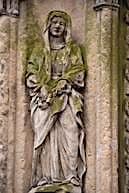
Detail of the Rostropowicz family tombstone.
The king and Bacciarelli did not succeed in establishing an Academy of Fine Arts in Warsaw. Despite the efforts of the painter, who was loyal to the monarch, a chair of sculpture in Warsaw was not established until 1817, at the Royal University of Warsaw, founded in 1816. The chair was taken up by Paweł Maliński (1790–1853), a graduate of the Academy of Fine Arts in Dresden, brought from Bohemia by Stanisław Zamoyski. From then on, Warsaw teemed with local sculptors—Poles or foreigners who quickly became Polonised. Like the most distinguished pupils of Paweł Maliński, Jakub Tatarkiewicz (1798–1854) and Konstanty Hegel (1799–1876), as well as Ludwik Kaufmann (1801–1855), brought over by Ludwik Pac, they carried out private and government commissions, which provided them with steady work. They decorated private residences and public buildings, and also undertook funerary art. However, this was not their only work. After the November Uprising, the University in Warsaw was closed, and in 1848 the organisation of art exhibitions was prohibited; in their place, exhibitions of handicrafts and industry were introduced. They took place every four years, each time in a different city—St Petersburg, Moscow or Warsaw. The School of Fine Arts was not opened until 1844, when it was attached to the Real Gymnasium, established in 1841 in Kazimierz Palace. Unfortunately, in 1851 Tsar Nicholas I curtailed its activities, and in 1864 his son Alexander II closed it for good. After a long hiatus, during which it operated solely as a Drawing Class from 1865, later known as Wojciech Gerson's School, a private School of Fine Arts was established in 1904. Alongside painters, Adam Krasiński and Maurycy Zamoyski joined the founding committee, while Xawery Dunikowski took charge of sculpture. After various upheavals, the school was transformed into the Academy of Fine Arts. It is easy to imagine, then, how much effort, determination and genuine vocation it took to devote oneself to this field of art.
In her comprehensive compendium Warsaw Sculptors of the 19th Century, Maria Irena Kwiatkowska gives numerous examples of talents that went to waste, never having the chance to fully develop because society was growing poorer. Even a significant part of the aristocracy left Warsaw; Stanisław Zamoyski is the most notable example. The impoverished landowning class, driven into the city after the uprisings, commissioned little more than small plaster figurines of national heroes. The newly arrived bourgeoisie of Jewish or German origin, although quickly Polonised and often buyers of works of art, tended to purchase sculptures abroad, especially since, as mentioned above, exhibitions were not being held and people could not become familiar with local work. Even at exhibitions organised by the Society for the Encouragement of Fine Arts, founded in 1860, painters were favoured, while sculptures were often displayed in unsuitable places. Painting was simply easier to sell. Even sculptors who worked for many years for influential art lovers, such as Henryk Stattler (1834–1877), employed by the Potockis and the Czartoryskis, and by Leopold Kronenberg (the elder), for whom he made a marble statue of Mickiewicz late in life, ended up working stone for the reconstruction of Warsaw's fire-damaged town hall. As the sculptor's friend wrote in an obituary quoted by Maria Irena Kwiatkowska, Stattler "died in utter poverty, leaving two underage orphans, whose mother had died before him." He was buried at Powązki (section 75-2) beneath the simplest stone slab, the kind that disappears most quickly and is replaced by entirely new graves. In the Catacomb Avenue, he left a bust of Jan Dekert, one of the finest realistic portraits in Polish sculpture. Nowhere else in Europe was the situation like ours, as Maria Irena Kwiatkowska writes, quoting the Illustrated Weekly from 1890: "all our local sculptural activity must be confined to producing tombstones, stuccowork, medallions, commissioned decorations for buildings and churches, commissioned busts and similar work." Unfortunately, even commissions for cemeteries were not always secure. Warsaw sculptors worked for people of all faiths, regardless of their own, something that never seemed unusual in the multi-faith Polish-Lithuanian Commonwealth. A few of the best-known artists will suffice: Ludwik Kaufmann, creator of the mourning figure at Powązki on the grave of merchant Mioduszewski and of bookseller Merzbach's tombstone in the Jewish cemetery; Bolesław Syrewicz, creator of numerous monuments at Powązki, who also worked at the Evangelical-Augsburg and Orthodox cemeteries; Andrzej Pruszyński, who created most of his works at Powązki and the Evangelical-Augsburg cemetery; and Jan Kryński, winner of the competition for a monument to the heroic pastor and member of the Polonia student fraternity in Dorpat, Zygmunt Otto.
The Lutheran Teodor Gundelach left his works at Powązki, including a Madonna bas-relief on Antoni Tischler's tomb. It was more difficult for someone who chose wood, such as Hegel's student, the Jewish sculptor Joachim Saltzman (Zalcman), author of many crucifixes that burned in Warsaw's churches. Despite such an open market, there were not enough ambitious commissions, especially as many wealthy potential clients were Jewish, and their religious laws forbade the depiction of the human face. Even the outstanding Jewish sculptor Abraham Ostrzega, whose work dates mainly to the interwar period, saw his works destroyed by fellow Jews. Reformed Protestants, who preferred noble simplicity and austerity, were also reluctant to commission expensive tombs. Sculptors therefore often set up stoneworking, stucco and foundry workshops, which helped them make a living while also influencing the artistic quality of even the most modest objects. After Poland regained its independence, the situation changed dramatically. Monuments were commissioned through competitions throughout the country, and government and municipal buildings were decorated. Although Powązki's importance was not forgotten—in 1925, for instance, the Avenue of the Distinguished was laid out along the back wall of the catacombs—genuine works of art continued to appear in the cemetery alongside average, frequently copied tombstones. Interestingly, in the last quarter of the 19th century, women began to take up sculpting in Warsaw. The men, often stonemasons, carved only the heaviest sections of stone, usually following a plaster model made by the female artist. Maria Gerson-Dąbrowska pioneered women's work at Powązki; medallions made by her hand adorned many tombs, such as those of Władysław Siwiński (section 5-1) and Wanda and Jan Lemański (section 62-1). In the interwar period, other women joined her—Hanna Nałkowska-Bickowa, Olga Niewska-Szczekowska, Hanna Bienulis-Strynkiewiczowa and Janina Broniewska. Their work, like that of their fellow sculptors Xawery Dunikowski, Edward Wittig and Henryk Kuna, can be admired not only in cemeteries. After the Second World War, interesting artistic works appeared mainly in the Avenue of the Distinguished. Artists already known before the war, though not necessarily for works in Warsaw cemeteries, such as Jan Szczepkowski, Antoni Kenar, Bohdan Pniewski, Ludwika Nitschowa and Zofia Trzcińska-Kamińska, were joined by others: Tadeusz Łodziana, Barbara Zbrożyna, Franciszek Strynkiewicz and Gustaw Zemła. Tomasz Rogala, co-author of the excellent guide published by the Social Committee for the Care of Old Powązki, gives a rather poor assessment of the final decade of the 20th century, and it is difficult to disagree with him. He considers the Cassel-Kolczyński tomb (section 21-1) the finest; interestingly, it was designed and built in 1995 by art conservators.
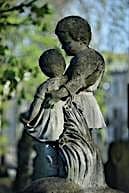
The Bohusz family tomb.
Even the word cemetery comes from coemeterium, a Latin borrowing from Greek meaning a place of sleep, a place of rest. Likewise, catacombs, also a Greek borrowing, literally means underground tombs, an underground cemetery. The establishment of Powązki coincided with the long-established presence of Classicism in Poland. A renewed interest in antiquity began in Europe with archaeological excavations: Herculaneum was unearthed in 1711, and Pompeii in 1748. In 1764, Joachim Winckelmann, the father of art history, published The History of Ancient Art. In the 1770s, archaeologists carried out excavations at Nero's Golden House, and in 1776 drawings documenting the work were published in the collection Vestigio delle terme di Tito (Mars and Venus Surprised by the Gods). They were engraved by the Roman printmaker Marco Carloni, based on works by Franciszek Smuglewicz and Vincenzo Brenna. Since Warsaw, as the monarch's seat, was then Poland's largest gathering place for the aristocracy, and the Grand Tour of Europe completed one's education, new trends spread fastest here, too. In 1815, Stanisław Kostka Potocki, Poland's first archaeologist and the founder of the museum in Wilanów, published O sztuce u dawnych, czyli Winkelmann polski (On Art among the Ancients, or the Polish Winckelmann), a translation of the German original, albeit in a substantially revised and improved version. Enlightenment thinkers such as Winckelmann and Potocki sought in antiquity an order, a set of cool, mathematical laws that confirmed that everything could be known. What is more, everything had already been discovered; it had merely been forgotten. All that remained was to imitate it precisely. The basic features of Classicism are symmetry; the use of architectural elements drawn from ancient architecture—columned porticos, colonnades and triangular pediments; statues modelled on ancient examples; decorative bas-reliefs on friezes and tympana; and freestanding columns and sarcophagi used as garden ornaments. One example is the sarcophagus serving as the Monument to the Battle of Raszyn in Wilanów, later replicated at Powązki, first on Cyprian Godebski's tomb.
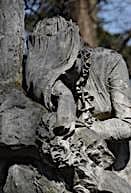
The Piaszczyński family grave.
A shattered column or tree symbolized a life cut short. Since for the next hundred years, teaching at academies would consist of copying the works of old masters, usually from plaster casts, antique motifs would be repeated in successive styles—right up to Art Nouveau—and the perception of the human body would remain essentially unchanged. Example I. The most typical representation, repeated many times later, was that of a mourning woman. At Powązki, the gravestone of Julia Piotrowska (section 8-1) is considered the finest example of this motif. Its creator was Jakub Tatarkiewicz, who worked for the Potocki family and was a pupil of Thorvaldsen, the most distinguished sculptor of classicism, whom his master held in high regard. The woman, dressed in antique robes and leaning on a flower-wreathed urn, is modelled on Thorvaldsen's figure of Polonia from the monument to Marshal Małachowski, which can be viewed and compared at the Archcathedral Basilica of St. John the Baptist in Warsaw. Neo-Gothic style—In 1750, Horace Walpole, son of Britain's first prime minister, asked architects Richard Bentley and John Chute to build a castle to his design. Construction of the Neo-Gothic Strawberry Hill was completed in 1775, and its co-designer and owner published the Gothic novel The Castle of Otranto in his own printing house, anonymously. The new movement continued to gain ground. In 1802, at Wilanów, the enlightened minister Stanisław Kostka Potocki—like many patrons, often collaborating and co-designing with his favourite architect, Christian Piotr Aigner—decided to build a gallery known as the Gothic Gallery. Aigner drew up the plans reluctantly, muttering "Mamelukes!" under his breath. After all, he read
the works of his masters: Alberti and Vasari, and remembered where the contemptuous term "Gothic" came from: the work of the Goths, barbarians without education or taste. The style nevertheless caught on. In 1836, Stanisław Kostka's son, Aleksander, erected a mausoleum for his parents at Wilanów. The statues of Stanisław Kostka and his wife, Aleksandra née Lubomirska, carved by Tatarkiewicz in the style of the royal statues at Wawel, were placed beneath a Neo-Gothic canopy designed by Henryk Marconi. Ten years later, Jakub Tatarkiewicz, designing a tomb for Cecylia née Wołowski Krysińska (section 8-3), created another reinterpretation of the Sleeping Ariadne in the Vatican. In Poland, Monaldi had reproduced the figure on the gravestone of Maria Radziwiłłowa in Szydłowiec. He also placed a Neo-Gothic canopy above the statue. Count Sergey Uvarov, the Russian minister of education, also chose and designed a Neo-Gothic tomb, although it is the least soaring of those found at Powązki. He came from a Tatar family that had been Russified, studied in Göttingen, travelled around the world, wrote exclusively in German or French, and supported the ideology of "Orthodoxy, autocracy, nationality"—a motto added to his coat of arms. At the same time, he had an exceptional fondness for Poles. His most famous portrait was painted by Franciszek Ksawery Kaniewski, Kokular's successor at the School of Fine Arts and one of the founders of the Society for the Encouragement of Fine Arts. When the minister visited the School of Fine Arts, he was impressed by the work of student Antoni Mianowski and funded a scholarship for him. When Mianowski died the following year, the count used the scholarship money to pay for a monument, cast in iron with great artistry (section 10-5). What is surprising is the count's coat of arms at the centre of the Neo-Gothic canopy, although this may have symbolically signified adoption. The coat of arms is in its original form, without the ribbon. The style's characteristic features include soaring verticality, lightness, walls of little mass, large glazed window openings and pointed arches. These features were all emphasized through architectural details—flying buttresses, gables, tracery and pinnacles. Example II. The gravestone of Wojciech Białoskuni (section 22-2). It should be noted straight away that the openwork, soaring cast-iron tower by an unknown artist, cast at the ironworks in Białogon, is neither as tall nor as artistically accomplished as the twelve-metre tower on the Lilpop family grave (section B-1-2), the tallest at Powązki, designed by Marconi. It is worth noting for two reasons. First, this form was chosen by the widow of the heir to Mała Wieś, who died at the age of 34, demonstrating how intellectual currents were spreading throughout the country. Second, a statue of the Madonna was placed beneath it. Such depictions are characteristic only of Catholic cemeteries, since Protestants do not venerate saints, while Orthodox Christians depict them on icons.
Romanticism, historicism, eclecticism, realism – throughout the nineteenth century, different movements coexisted and intermingled, and none of them was uniform. They all relied on the classical, academic depiction of the human body; architecture, too, drew on familiar forms that had been known for a long time. This was often explained by the emergence of a new social class – the industrial bourgeoisie – whose tastes had not yet fully developed, and which readily embraced conservative forms and highly ostentatious, richly decorated buildings. Eclecticism and historicism differed mainly in how they combined elements. Eclecticism allowed for the compilation of styles from different eras and cultures, while historicism more often adhered to the imitation of a single style, adding the prefix "neo" to it (Neo-Gothic, Neo-Romanesque, Neo-Renaissance, Neo-Baroque). The combination of different historical styles was called eclecticism. Today, with the benefit of hindsight, art history assesses historicism and eclecticism differently. It is always worth remembering that the eighteenth century was the age of the encyclopaedists. Europeans raised on their ideas wanted to demonstrate their detailed knowledge of things at every turn. Even if, following the Romantics, they most valued the history and styles disliked by the Enlightenment, they still imitated individual elements with the precision of Enlightenment thinkers; only their new application and combination was creative. Just when Classicism seemed to reign supreme, Neo-Gothic appeared first. Gothic novels and Walter Scott's tales of chivalry drew attention to the immaterial side of reality, to the world of myths and legends. All of this became intertwined with freedom movements in Europe. The younger generation began to notice the immaterial side of reality. The greatest hero was Lord Byron, who, dying among the Greeks fighting for freedom in 1824, wished to leave his heart beneath a tree (the cult of nature) in Missolonghi. Romanticism therefore first appeared in literature and music, then quickly found expression in the visual arts, first in painting and later in sculpture. Even the assessment of the monument to Prince Józef Poniatowski prompted criticism. The Romantics wanted him to look realistic, in his uhlan uniform and czapka, which he never took off. Realistic depictions began to appear, and alongside the cult of nature came a fashion for folk culture. The cemetery began to fill with figurative sculptures as never before. In most cases, clothing was reproduced in precise detail. People loved grand gestures and mystery, even in ordinary academic depictions. Many religious symbols appeared in the cemetery. In the Classical period, religious affiliation was usually indicated by a simple cross; now, more and more decorations associated with Christianity began to appear, such as the anchor or the flaming heart. Increasingly, the place of the mourner
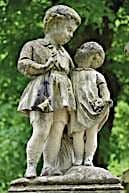
The Bohusz family tomb.
The mausoleum is topped by a small chapel with a statue of the Virgin Mary and an oversized cross, added later and disrupting the proportions. Example IV. The tombstone of Maniusia Lipowska and Stefcik Kamieński, by Jan Woydyga (section 11-6). A Romantic subject combined with academic realism. A classically styled angel holds a winged hourglass in one hand, symbolizing the passage of time, and an extinguished torch, pointing downwards, in the other, signifying a life brought to an end. Within the folds of the angel's cloak are two children with very peaceful expressions, beneath the wings of a guardian angel who is sad, though protective. This is not the only children's tombstone in Powązki. Romanticism began an entire series of them, thus returning to tradition. The first Renaissance children's tombstone north of the Alps was made in Poland, in the Opatów Collegiate Church, for Ludwik Szydłowiecki. The children depicted on other tombstones in Powązki are usually dressed in contemporary clothing, as, for example, in the work of Faustyn Cengler (see the Bohusz family tomb, section 175). Example V. The eclectic tombstone of the Herman family (section T-6). On a tomb chest set on a pedestal stands a barefoot woman in antique-style robes, her face veiled. In her hands she holds a wreath – a symbol of eternity – and a palm branch, a symbol of redemption, also used in other Christian cemeteries and in the Jewish cemetery. Syrewicz was probably inspired by Antonio Corradini's sculpture Modesty (1751) in the Sansevero Chapel in Naples. Example VI. The tombstone of Zygmunt Gloger, sculptures by Bartłomiej Mazurek, portrait plaque by Czesław Makowski (section 52-2). Zygmunt Gloger was an eminent ethnographer and co-founder of the Polish Tourist Society and the Society for the Care of Historical Monuments. The spinning woman sculpted by Bartłomiej Mazurek is not only one of the numerous folk motifs so popular at the time that even Italian works were imported (the Reaper on the grave of Feliks Zakrzewski, section 161-1, by Luigi Panzeri), but also a reminder of the ethnographer's work.
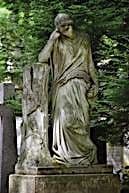
Aleksander Janicki's tombstone.
Ornamentation was mainly floral and animal-themed, although Austria favoured a more geometric and restrained style. Artists also began to deform the human body in ways never seen before, and scorned all the hallowed conventions of the past. The new style quickly gained both supporters and opponents. Some admired its unsettling, vibrant character; others saw it as almost scandalous moral depravity. In his book on Art Nouveau, Mieczysław Wallis quotes the telling words of Karol Irzykowski, who summed up the views held by Polish conservatives in 1900 as follows: "It was known that the building was to be in the Art Nouveau style, and the very name bore witness to a crime: anyone who built in the Art Nouveau style must therefore be a socialist, an atheist, an apostate; he was not even Polish, nor had a Polish mother nursed him." Art Deco, which emerged from the Kraków Workshops, was something else entirely. It too showed a great fondness for rich ornamentation, but unlike Art Nouveau, it loved symmetry and solid geometric forms. Artists working in this style emulated the methods of folk artists and makers of exotic art, such as African art. Some evolved towards Cubism, others towards academic Classicism. Art Deco in Poland reached a truly high standard, as shown by the fact that Poland won more awards than any other participating country at the 1925 International Exhibition of Modern Decorative and Industrial Arts in Paris. As late as 1964, Karol Tchorek recreated in stone the wooden angel from the Paris exhibition on the grave of the angel's creator, Jan Szczepkowski (Avenue of the Distinguished). Example VII. Tombstone of Wacław Szymanowski senior (section 40). Wacław Szymanowski junior, creator of the Chopin Monument in Warsaw. A typical
example of Art Nouveau: a deformed human body, since it is difficult to make out two human figures in this metal mass, tilted away from the gravestone at an obtuse angle. All the more so because another face, shown frontally, is visible on this undulating surface. Only when our gaze travels upwards do we see two female figures emerging from the mass. One wrings her hands, the other hides her face in her hands. This is one of the finest and most interesting Art Nouveau monuments at Powązki. Example VIII. Tombstone of Stanisław and Janina Pruszkowski (section 2-3), by Zofia Trzcińska-Kamińska. A fully sculpted figure stands on a massive pylon: a classical nude of a dying warrior. The figure wears military trousers and boots. On the front wall, a bas-relief depicts two heads in profile, with their eyes shown frontally. The woman's hair and shawl are rippled, enhancing the impression of movement. The combination of a classical nude and Egyptian motifs is a modernised form of decorative art. A distinguished yet underappreciated sculptor, who served in the Legions disguised as a man, commemorated here Stanisław Pruszkowski, who fell in 1920, and his wife, who took her own life after his death. The period after the Second World War was not uniform: many people who worked in sculpture continued to do so after the war, including the aforementioned Zofia Trzcińska-Kamińska. For a long time, however, the public was unable to choose a monument and erect it on a chosen grave, as happened for many years with the symbolic grave of President Starzyński, the grave of Marshal Śmigły (for a very long time, only a birch cross stood there), and the memorial to those killed in the East. This is not to say that there were no notable works. Abstract works deserve particular attention, such as those by Barbara Zbrożyna and Piotr Potworowski, which, despite their abstract form, fit perfectly into the cemetery's style and attest to the continuity of national art. Every walk through the cemetery invites us to discover new meanings, because even such common symbols as ivy, signifying eternal life, or a flaming vase, signifying love of God, can also be used as a symbol of intelligence. Just as the swastika found at Powązki is a religious symbol of happiness and good fortune. Powązki is not only the cultural heritage of the entire nation, but, despite the many remarkable agnostics and atheists buried here, it is a Catholic cemetery, where many