Primate Stefan Wyszyński
Marshal Józef Piłsudski
What are historic monuments if not preserved, visible signs of the past? Monuments of art and culture are a bridge connecting the past with the future; they bear witness to our history, preserving the memory of our ancestors' deeds, their lives, intentions and preferences. Under Polish law, a historic monument is defined as "an immovable or movable object, or parts or groups thereof, created by human beings or connected with their activity, which bears witness to a bygone era or event and whose preservation is in the public interest because of its historical, artistic or scientific value." Historic monuments are therefore evidence of national culture and of its distinctive features, as well as valuable property belonging to society as a whole. No generation has the right to consider itself the owner of cultural heritage; it is merely its temporary custodian, entrusted with the duty of preserving it and passing it on to future generations in as unchanged a form as possible.
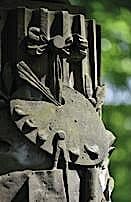
A fragment of Jan Feliks Piwarski's tombstone.
Numerous sources and studies, as well as conservation research carried out directly on historic monuments, show that the need to care for the creative achievements of previous generations has been felt and understood since ancient times. To protect objects considered worthy of preservation, which had already begun to age and gradually deteriorate, a range of technical and aesthetic treatments were carried out, interfering to varying degrees with the original structure of individual elements. These were not the kinds of treatments we today call conservation practice. The conservation of works of art as a scientific discipline, whose purpose is the deliberately organised care and protection of historic objects, emerged only in the second half of the 19th century and was closely linked from the outset with fields such as architecture and art history. Its principles were not defined and established from the beginning, since it was only towards the end of the 18th century that people began to recognise the social value of historic objects and mementos of the past. During the French Revolution, decrees were issued providing for state care of works of art and emphasising their exceptional role in the development of fields connected not only with art, but above all with education. In other European countries, too, interest in the heritage of the past grew in the first half of the 19th century. People began to recognise the positive influence of works of art—witnesses to the history of bygone centuries—on society as a whole. In Polish lands, organised forms of care for historic monuments began to develop in the early 19th century, particularly in Galicia, which at the time was within the Habsburg Empire.
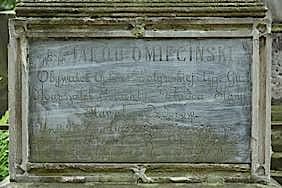
Jakób Omieciński's grave.
However, these efforts were guided more by free artistic interpretation than by clearly defined scientific principles. Growing public interest in the conservation and care of monuments—not only in Polish lands but also in other parts of Europe—was driven by the numerous wars and conflicts at the turn of the 20th century. Many valuable buildings were destroyed as a result of warfare. In the second half of the 19th century, conservation theories began to emerge, based on a scientific and practical approach to monuments. Conservators began focusing on strengthening the structures of buildings at risk of collapse and removing the causes of their deterioration and destruction. Research into conservation techniques and technologies, as well as art history, was initiated and later expanded on a larger scale in the interwar period. Its aim was to examine and define the techniques and materials used to construct buildings in past centuries. The Second World War had tragic consequences not only for the citizens of the countries involved in the conflict, but also for monuments located in the areas of fighting. The war caused widespread destruction, and Warsaw was one of the cities most severely affected. Monument conservators and architects faced a major challenge: they had to determine conservation methods not for individual historic buildings or their fragments, but for entire urban complexes that had been almost completely razed to the ground. This led to a sense of shared responsibility in many countries for preserving the buildings that constitute Europe's cultural heritage. Numerous international organisations were established to promote conservation principles based on the need to preserve historic fabric and, as far as possible, the authenticity of buildings, while at the same time
Primum non nocere, or "first, do no harm," is one of the foremost ethical principles in medicine. This rule is also a duty of conservators towards monuments, just as it is a duty of doctors towards people and animals, because once the good condition of a work of art or a person's health has been lost, it is difficult to restore. The task of art conservators is therefore to prevent and treat the "illnesses" that afflict historic objects. Destructive factors must be eliminated, and if an object has already been "infected," the causes of its deterioration must be removed so that the damage does not progress. To preserve works of art for as long as possible in a form that has changed as little as possible, conservation treatments should be chosen so that intervention in the object's structure is minimal and the effect on its historic fabric does not alter the monument's character. It is also important to ensure that conservation treatments can be reversed, so that, if necessary, the object can be returned to its condition before intervention should research into new conservation technologies yield a more effective way to halt the deterioration of original elements of monuments. For this reason, in addition to knowledge of art history, conservation techniques and technologies, microbiology and other fields related to the protection of monuments, conservators are expected to possess a special talent and sensitivity to perceive all those subtleties that cannot be described or set down in regulations. The conservation of works of art is a field in which knowledge gained through science and art complement each other.
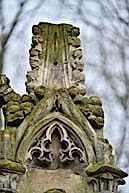
The Rostropowicz family tomb.